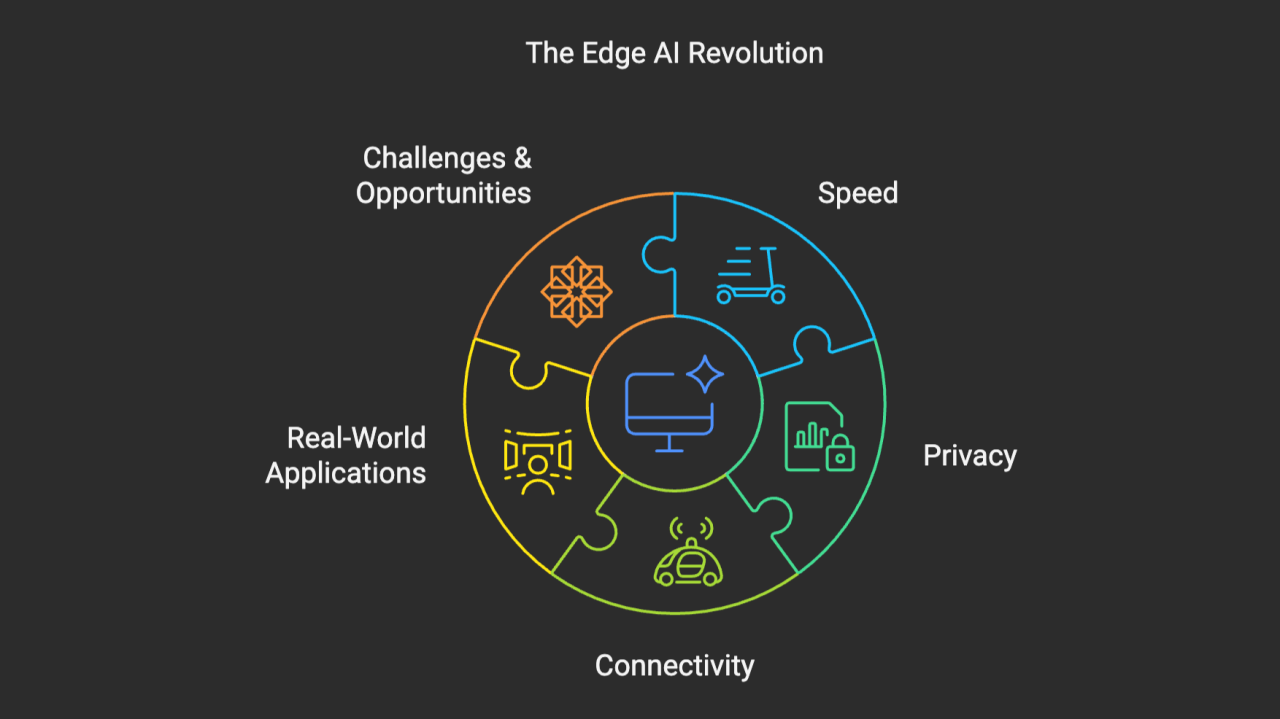
Introduction
Artificial intelligence is becoming an important part of everyday life. From voice assistants and smart home devices to recommendation systems and intelligent business applications, AI is changing how people interact with technology. Most people experience AI through applications that rely on powerful computers in remote data centers. When a user asks a question, uploads a photograph, or requests an AI-generated response, the information may travel across the internet to be processed on distant servers before the result returns to the device.
Although this approach has enabled remarkable technological progress, it also creates challenges involving internet connectivity, response times, privacy, and computing costs. As AI becomes increasingly integrated into everyday activities, the need for faster, more accessible, and more efficient intelligent systems is growing.
This is where Edge AI enters the picture.
Edge AI refers to the use of artificial intelligence directly on devices or on nearby computing infrastructure rather than relying entirely on remote cloud servers. These devices can include smartphones, security cameras, wearable technology, industrial sensors, vehicles, and smart home appliances. By processing information closer to where it is generated, Edge AI can make intelligent services more responsive and potentially more private.
Imagine a security camera that identifies unusual activity without continuously sending video footage to a remote server. Consider a smartwatch that detects changes in movement patterns directly on the device, or a factory sensor that identifies signs of equipment failure before a breakdown occurs. These are examples of how Edge AI can bring intelligence closer to the people and environments that need it.
As processors become more efficient and AI models become smaller, Edge AI is creating new opportunities across healthcare, education, transportation, agriculture, manufacturing, and consumer electronics.
The revolution is not simply about making devices smarter. It is about changing where intelligence operates, how quickly it responds, and how naturally it fits into everyday life.
1. Understanding Edge AI
Edge AI combines artificial intelligence with edge computing. To understand this combination, it helps to examine the two concepts separately.
Artificial intelligence enables computer systems to perform tasks such as recognizing images, understanding speech, detecting patterns, and making predictions. Edge computing brings data processing closer to the source of that information instead of sending everything to a centralized data center.
When these technologies are combined, AI models can run directly on local devices or on nearby computers that serve a specific location.
For example, a conventional cloud-based security camera may send video to an online server for analysis. An Edge AI camera can analyze the footage locally and transmit only important alerts or selected information.
Similarly, a smartphone equipped with an appropriate AI model can perform certain image-processing, speech-recognition, or language tasks without sending every request to a remote service.
Edge AI does not mean that cloud computing becomes unnecessary. Complex tasks may still benefit from powerful cloud infrastructure. Instead, Edge AI creates a more flexible approach in which some operations happen locally while others take place in the cloud.
The choice depends on the task, the available hardware, the required response time, privacy considerations, and the complexity of the AI model.
This combination of local and remote intelligence is becoming an important foundation for the next generation of connected devices.
2. Why Edge AI Is Becoming Important
Several technological developments are contributing to the growing interest in Edge AI.
Faster response times
Applications such as autonomous machines, industrial monitoring systems, and interactive devices often need to respond quickly. Sending data to a distant server and waiting for a response can introduce delays.
Local AI processing can reduce this delay by allowing devices to analyze information and respond without depending on a remote connection for every operation.
Improved privacy
Many everyday devices collect sensitive information, including voice recordings, images, location-related information, and personal activity patterns.
Processing information locally can reduce the amount of personal data that needs to leave a device. Although local processing does not automatically guarantee privacy, it can make privacy-preserving designs easier to implement.
Reduced dependence on internet connectivity
Not every environment has reliable internet access. Rural communities, remote industrial facilities, farms, and transportation systems may experience limited connectivity.
Edge AI allows certain intelligent functions to continue operating even when the connection to a cloud service is slow or unavailable.
Lower communication costs
Transmitting large amounts of data continuously can be expensive and energy-intensive. Edge devices can filter information locally and send only useful summaries, alerts, or selected records.
Growing hardware capabilities
Modern processors increasingly include specialized components designed to accelerate AI calculations. These components can run selected models efficiently while using less power than general-purpose processing alone.
Together, these developments are making it practical to bring AI into devices that were previously too small, inexpensive, or energy-constrained to support sophisticated intelligence.
3. Edge AI in Smartphones and Personal Devices
One of the most visible applications of Edge AI is the smartphone.
Modern smartphones already perform many intelligent tasks locally, including facial recognition, image enhancement, voice processing, and certain predictive functions. As mobile processors improve, more AI capabilities can operate directly on the device.
For example, a smartphone camera can recognize a scene, improve lighting, reduce image noise, and optimize colors while a photograph is being captured. Some devices can also provide AI-assisted transcription, text summarization, and language-processing features locally, depending on the hardware and software available.
These capabilities can improve the user experience because they reduce dependence on network availability and may produce results more quickly.
Personal devices could also become more context-aware. A phone might organize information, identify useful details in documents, or help users manage daily activities while keeping selected information on the device.
Wearable technology is another important area. Smartwatches and fitness trackers can analyze movement, estimate activity levels, and identify patterns in collected sensor data. Some systems may support local detection of irregular events and notify users when further attention is appropriate.
However, these devices should not be treated as perfect sources of medical information. Health-related measurements can be inaccurate, and important decisions may require professional assessment.
The broader trend is clear: personal technology is gradually moving from being a passive tool that responds to commands toward becoming a more intelligent assistant that can recognize context and provide timely support.
4. Transforming Healthcare Through Edge AI
Healthcare is one of the areas where local intelligence could make a meaningful difference.
Hospitals, clinics, and home-care environments increasingly use connected devices to collect information about patients. However, transmitting every measurement to a remote server may introduce delays, create privacy concerns, or make services less reliable when connectivity is limited.
Edge AI can process selected information close to the patient, allowing devices to identify patterns and generate alerts without continuously depending on cloud infrastructure.
For example, wearable devices can analyze movement and heart-rate patterns locally and notify users or healthcare professionals when predefined conditions warrant further attention. In hospitals, intelligent monitoring equipment could help staff identify unusual changes in patient measurements more quickly.
Portable diagnostic devices may also benefit from local AI. In areas with limited medical infrastructure, selected tools could assist trained healthcare workers in interpreting medical images or organizing diagnostic information without requiring constant access to powerful remote systems.
Another potential application is the intelligent processing of medical images. Local systems could help prepare images for review, identify areas that deserve closer examination, or assist clinicians in managing large volumes of information.
Nevertheless, healthcare applications require strict safeguards. AI-generated findings must be appropriately validated, patient data must be protected, and medical professionals must retain suitable oversight of clinical decisions.
Edge AI is not a replacement for doctors, nurses, or established diagnostic procedures. Its value lies in potentially making useful information available more quickly and reliably, especially in environments where time and connectivity matter.
5. Smart Homes and Everyday Convenience
Edge AI is also helping transform houses into more responsive and efficient living spaces.
Traditional smart home devices often rely on cloud services to interpret voice commands, process recordings, or coordinate connected equipment. While cloud computing remains useful, local AI can enable some functions to operate more quickly and privately.
A smart speaker with local speech recognition may respond to certain commands without sending every spoken request to an external server. A smart thermostat could learn patterns of household activity and adjust heating or cooling based on local information.
Security systems can also benefit. An intelligent camera may distinguish between people, animals, vehicles, and ordinary environmental movement, reducing unnecessary notifications. Local processing can help limit the amount of video footage transmitted outside the home.
Edge AI may also improve energy management. Connected devices can monitor electricity usage, recognize recurring patterns, and adjust selected settings to reduce unnecessary consumption.
For older adults and people with disabilities, intelligent home systems could provide additional convenience through voice control, automated lighting, and alerts about unusual activity. Such applications must be designed carefully to protect privacy and avoid making intrusive assumptions about residents.
Despite these possibilities, smart homes face challenges involving device compatibility, cybersecurity, maintenance, and user control. A locally intelligent device can still be vulnerable if its software is outdated or its network is poorly secured.
The goal should be to create technology that makes everyday life easier without making homes unnecessarily complicated or invasive.
6. Edge AI in Transportation and Autonomous Vehicles
Transportation systems generate enormous amounts of information through cameras, radar, lidar, GPS receivers, and other sensors.
Vehicles must often interpret this information quickly to detect obstacles, monitor surroundings, and respond to changing road conditions. Relying exclusively on distant cloud servers for time-critical decisions would introduce unacceptable delays in many driving applications.
Edge AI allows vehicles to process selected sensor information locally. Onboard systems can identify objects, estimate their movement, monitor driver attention, and support driver-assistance features.
For example, a vehicle’s onboard computer may analyze camera footage to recognize lane markings or detect a pedestrian. It can then provide a warning or support an appropriate vehicle response according to the capabilities and safety design of the system.
Similar principles apply to public transportation. Local intelligence can help monitor vehicle components, identify maintenance issues, and improve the management of fleet operations.
In urban environments, edge computing infrastructure may also help analyze traffic patterns, monitor intersections, and support intelligent transportation services.
However, autonomous driving remains a demanding safety challenge. Lighting conditions, severe weather, unusual road layouts, and unexpected human behavior can create situations that are difficult for AI systems to handle.
The presence of Edge AI does not automatically make a vehicle autonomous or safe. Such systems require extensive testing, robust engineering, regulatory compliance, and appropriate human supervision.
Its main advantage is that it allows critical information to be processed close to where action is needed, reducing dependence on external connectivity for essential functions.
7. Revolutionizing Manufacturing With Edge AI
Manufacturing is another industry where Edge AI can deliver practical benefits.
Factories depend on machines, sensors, production lines, and quality-control systems that operate continuously. Unexpected equipment failures can cause costly downtime, while defects in finished products may lead to waste and customer dissatisfaction.
Edge AI can help address these challenges by analyzing operational information directly on machines or nearby industrial computers.
One important application is predictive maintenance. Instead of waiting for equipment to fail or replacing components according to a fixed schedule, intelligent systems can analyze vibration, temperature, sound, and other sensor readings to identify patterns associated with possible faults.
When a machine begins showing unusual behavior, the system can alert maintenance staff before the problem becomes more serious.
Another application is automated quality inspection. Cameras equipped with AI models can examine products as they move along production lines, identifying visible defects or inconsistencies at high speed.
Local processing is particularly useful when inspections must happen immediately or when large quantities of video cannot be transmitted efficiently to a remote server.
Edge AI can also support production optimization by monitoring energy use, identifying bottlenecks, and providing operational insights.
However, industrial systems must be reliable and secure. An incorrect prediction could interrupt production or damage equipment, while a compromised connected device could affect critical operations.
Manufacturers should validate AI models under real operating conditions, maintain human oversight, and ensure that intelligent systems integrate safely with existing industrial controls.
When implemented responsibly, Edge AI can help factories become more efficient, responsive, and resilient.
8. Agriculture and Intelligent Farming
Agriculture faces increasing pressure to produce food efficiently while managing water, energy, fertilizer, and land resources. Farmers must make decisions in environments where conditions can change rapidly and internet connectivity may be limited.
Edge AI offers tools for analyzing information directly in fields, greenhouses, tractors, and agricultural equipment.
For example, a camera mounted on a farming machine could use local AI to distinguish crops from weeds. This information could help guide targeted weed treatment and potentially reduce unnecessary chemical use.
Soil sensors could analyze moisture conditions and support more precise irrigation. Local weather measurements and crop observations could help farmers identify areas that require attention.
Edge AI may also support livestock monitoring by analyzing movement patterns or identifying changes in behavior that deserve investigation.
In greenhouses, intelligent controllers can monitor temperature, humidity, and light conditions, then adjust equipment according to predefined rules and validated models.
Local processing is especially valuable when farms operate in remote areas where internet connections are unreliable. A device that can analyze information independently may continue functioning even when cloud services are unavailable.
However, agricultural environments are challenging. Dust, moisture, changing light, equipment vibration, and differences between crops can affect system performance. Farmers also need tools that are affordable, easy to maintain, and suitable for local conditions.
Edge AI will be most useful when it addresses specific agricultural problems rather than introducing complexity for its own sake.
9. Edge AI and the Internet of Things
The Internet of Things, commonly known as IoT, refers to networks of connected devices that collect and exchange information. These devices include environmental sensors, industrial monitors, smart appliances, tracking systems, and connected infrastructure.
As the number of connected devices grows, sending every measurement to centralized cloud services can become inefficient.
Edge AI helps address this challenge by enabling devices to analyze information before transmitting it.
Consider a network of sensors monitoring a water treatment facility. Instead of sending every reading for continuous remote analysis, local AI systems could identify unusual patterns and forward important alerts to operators.
Similarly, connected energy meters could analyze consumption locally and provide summaries to energy-management systems.
This approach can reduce network traffic, support faster responses, and improve resilience when communication links fail.
It can also help organizations manage large deployments of connected devices without requiring every device to maintain a continuous high-bandwidth connection.
Nevertheless, IoT and Edge AI systems create security challenges because each connected device can become a potential point of vulnerability. Devices need secure authentication, software updates, controlled access, and protection against unauthorized manipulation.
Interoperability is another issue. Devices from different manufacturers may use incompatible protocols or data formats, making integration difficult.
The combination of IoT and Edge AI has considerable potential, but its long-term success will depend on secure design, reliable standards, and effective device management.
10. Edge AI Versus Cloud AI
Edge AI and cloud AI are often presented as competing approaches, but they are better understood as complementary technologies.
Cloud AI uses centralized computing infrastructure to process information. It is well suited to tasks requiring large models, extensive datasets, and substantial computational resources.
Edge AI performs selected operations locally, often prioritizing low latency, offline functionality, and reduced data transmission.
The main differences can be summarized as follows:
| Feature | Edge AI | Cloud AI |
|---|---|---|
| Processing location | On a device or nearby system | Remote data center |
| Response time | Often lower for local tasks | Depends partly on network conditions |
| Internet dependency | Some functions work offline | Usually requires connectivity |
| Privacy | Can keep selected data local | May require transmitting data remotely |
| Computing resources | Often limited | Can scale to powerful infrastructure |
| Model updates | May require device-specific deployment | Can be centralized |
| Best suited for | Real-time, local, or connectivity-sensitive tasks | Large-scale, complex, or centralized tasks |
For many applications, a hybrid architecture is the most effective solution.
A smartphone might process routine voice commands locally while using cloud AI for more demanding requests. An industrial sensor might detect an unusual event on-site and send selected data to a central system for deeper analysis.
This division of work allows organizations to balance performance, cost, privacy, and computational requirements.
The future of AI will likely involve intelligent coordination between devices, local computing systems, and cloud infrastructure rather than a complete shift toward one approach.
11. Challenges Facing the Edge AI Revolution
Despite its advantages, Edge AI faces several technical and practical challenges.
Limited computing power: Small devices have restrictions involving memory, processing capacity, and battery life. Large AI models may need to be reduced or optimized before they can operate effectively.
Energy efficiency: Continuous AI processing can drain batteries and increase electricity consumption. Developers must balance model accuracy with power requirements.
Security risks: Devices operating in homes, vehicles, and factories may be physically accessible to attackers. Weak authentication or outdated software can expose sensitive information.
Model accuracy: A model trained under one set of conditions may perform poorly in another. Changes in lighting, weather, noise, or user behavior can affect its predictions.
Software maintenance: Organizations need reliable methods for updating AI models, correcting errors, and maintaining thousands of distributed devices.
Privacy limitations: Local processing can reduce data transmission, but it does not eliminate privacy risks. Devices may still collect sensitive information, retain unnecessary records, or expose data through insecure interfaces.
Cost and accessibility: Specialized hardware and maintenance can increase costs, particularly for smaller organizations and communities with limited technical resources.
Addressing these issues requires efficient AI models, secure hardware, thoughtful software design, continuous testing, and clear policies for data management.
Edge AI should be evaluated not only by what a device can do, but also by how safely, reliably, and economically it performs over time.
12. The Future of Edge AI
The future of Edge AI will be shaped by advances in semiconductor design, efficient machine learning, connectivity, and the growing demand for intelligent devices.
Smaller AI models are becoming increasingly capable of performing useful tasks with limited computing resources. Specialized processors are also improving the efficiency of AI calculations, making it possible to bring more intelligent features into consumer and industrial products.
As these developments continue, AI may become a standard capability in devices that previously relied on simple rules or basic automation.
Smart homes could become more responsive to residents’ preferences. Wearable devices may provide more personalized activity insights. Factories could identify operational problems earlier, while agricultural equipment may use local intelligence to reduce waste.
Edge AI may also contribute to more accessible technology. Devices that work without constant internet access could bring useful digital services to communities with limited connectivity.
At the same time, future systems will need stronger privacy protections, transparent controls, and effective methods for managing software updates and security vulnerabilities.
Businesses should prepare by identifying applications where local processing provides a genuine advantage. They should also assess hardware requirements, data protection obligations, maintenance costs, and the consequences of incorrect AI decisions.
The most successful applications will likely be those that solve specific problems reliably rather than adding intelligence simply because the technology is available.
Conclusion
The Edge AI revolution is changing how artificial intelligence reaches people and interacts with the physical world. By moving selected computing tasks closer to where information is generated, Edge AI can improve responsiveness, support offline functionality, reduce unnecessary data transmission, and create new opportunities for privacy-conscious intelligent services.
Its influence is already visible in smartphones, wearable technology, smart homes, industrial systems, transportation, and agriculture. As hardware and AI models continue to improve, these applications could become more capable and widespread.
However, bringing intelligence closer to everyday life also creates responsibilities. Devices must be secure, models must be tested under real-world conditions, and sensitive information must be handled carefully. Developers must balance intelligence with efficiency, reliability, and affordability.
The most promising future is not one in which every device operates independently. Instead, it is one in which edge devices, local computing infrastructure, and cloud systems work together to provide the right capabilities in the right place.
Ultimately, Edge AI represents a shift toward technology that is more immediate, more context-aware, and potentially more accessible. Its greatest contribution will not be measured by the number of devices that contain AI, but by how effectively those devices improve everyday experiences, support important decisions, and solve real problems.
As intelligence becomes embedded in the objects and environments people use daily, AI may gradually feel less like a separate digital service and more like a natural part of the world around us.